What goes with what
 Katerina Pavlakis
Good flavour combos don't belong to recipes
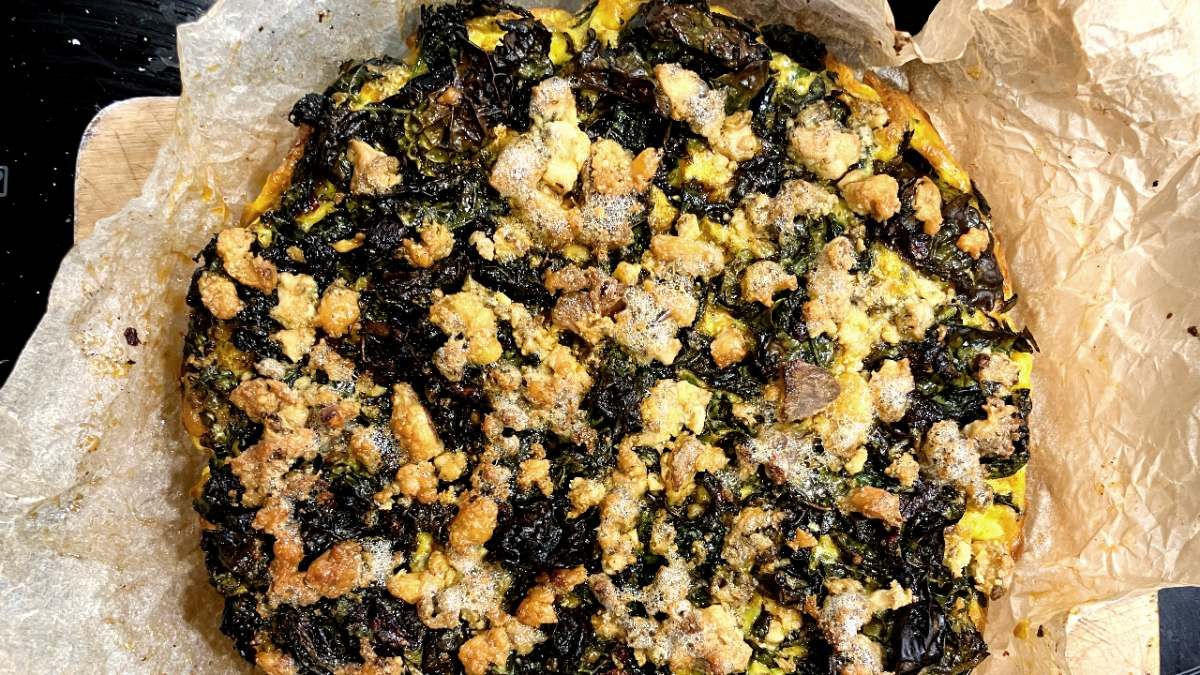
Yesterday I made a kale and blue cheese tart.
Not because I found a recipe for it. Nor because I studied what goes with what.
Because I had kale, I had blue cheese, and I had a thought:
Boccoli and blue cheese is a classic. One of those combinations you find hundreds (thousands?) of recipes for. Broccoli and blue cheese soup, gratin, pasta, etc... you know it works.
But I didn't have broccoli. I had kale.
And this thought: Kale is a brassica. Broccoli is a brassica. Blue cheese loves brassicas - the earthiness, the slight bitterness, the way a robust green stands up to something so bold and creamy and pungent.
That's the logic of the combination. And the logic is portable: it doesn't mind what kind of brassica, or which blue cheese.
You're not changing the combination - you're swapping one ingredient for another from the same flavour family. The logic holds. The result works.
(The tart was gorgeous, btw.)
That's how I think when I cook: I'm always looking for useful information I can take from one meal and use somewhere else.
And flavour combinations are particularly useful information.
Classic for a reason
There are flavour combinations we come across again and again.
Pork and fennel. Tomato and olives. Spinach and ricotta. Mustard and cream. Apple and cinnamon. Lemon and garlic.
Some belong to particular food cultures. Others have travelled and become so familiar that we barely think about them as combinations at all.
They didn't become classics because a chef declared them correct. They became classics because they've been tried tested, in real kitchens, by real cooks, across generations, and they just work.
Which means generations of cooks have already done some of the experimenting for us. Very handy!
But we often miss the most useful bit:
We associate the flavour combination with the dish.
Broccoli and blue cheese soup. Spinach and ricotta cannelloni. Pork and fennel sausages.
As if the specific combination was set in stone.
But it's not.
A good flavour combination is portable.
Once you notice it, you can take it somewhere else.
.
And here are three ways I do that:
1. Swap something similar
This is what happened with my tart.
I knew broccoli and blue cheese works.
I didn't have broccoli. I had kale. But I also knew that broccoli and kale are both brassicas. They're obviously not identical, but they share enough characteristics for me to make a reasonable guess that what works with one has a good chance of working with the other.
Not rocket science.
And you can do this all over the kitchen.
You don't need to know in advance whether somebody, somewhere, has written a recipe for the exact combination you're contemplating.
Look at what you do know.
If an ingredient isn't there, what have you got that's similar?
Same family? Similar flavour? Similar texture? Does it play a similar role in the dish?
You're not swapping blindly.
You're using clues.
2. Keep the flavours, change the dish
Some time ago now, one of my students told me that she absolutely loved spinach and ricotta cannelloni.
There was only one problem: She hated making it.
Stuffing slippery pasta tubes with spinach and ricotta was such a faff that she never cooked this at home. She only ever ate it in restaurants.
So I asked her:
What is it you actually love about the cannelloni?
She thought about it.
"The combination of spinach, ricotta and tomato sauce."
Well then...
Why make cannelloni?
Make a spinach, ricotta and tomato pasta sauce and eat it with ordinary pasta.
Or put the same combination onto baked aubergine. Or a jacket potato. Or use it in a quiche.
She was SO delighted by this idea.
Spinach, ricotta and tomato pasta became one of her staple weeknight dinners.
I love this story because I didn't actually teach her what flavours went together.
She already knew.
She had eaten spinach, ricotta and tomato together many times and knew she loved the combination.
What she hadn't noticed was that this was useful information she could take away from the cannelloni and use somewhere else.
That's quite a different way of looking at a dish.
Instead of asking: 'How do I make this?'
You can ask: 'What is it about this that I like?'
Now you've got something you can use again, in different ways.
3. Change the form
Sometimes you can take the idea even further.
Think about pork and fennel.
You might have encountered that combination in Italian-style pork sausages flavoured with fennel seeds (delish!)
But the useful information isn't:
Fennel seeds go in sausages.
It's:
Pork and fennel taste really good together.
And once you've noticed that, you can play with the form, while keeping the flavours.
- Rub crushed fennel seeds onto a pork chop.
- Braise fresh fennel and serve it alongside pork.
- Fry sliced fennel with bacon.
- Put pork and fennel into meatballs, a stew or a pasta sauce.
Same underlying flavours. Different ingredients, different techniques, different meals.
And you can do the same thing with all sorts of flavourings.
Fresh herbs can become pesto, herb oil or a herby sauce. Olives can become tapenade. Fresh tomatoes can become tinned tomatoes, passata or tomato paste. Lemon might mean juice, zest or preserved lemon.
The exact ingredient isn't always the important part. The flavour is.
Start collecting useful information
You don't need to learn hundreds of 'correct' flavour combinations before you can cook without a recipe.
(Spare yourself the overwhelm.)
Start with the combinations you already know you like.
Next time you eat something delicious, slow down to notice:
- What exactly do you like about it?
- What exactlky works well here?
Then take that little piece of information with you.
Could you use the same combination in a completely different dish?
Could you swap one ingredient for something similar?
Could one of those flavours show up in another form?
That's how one spinach and ricotta cannelloni can turn into a dozen dinner ideas.
And it's how you gradually build the kind of cooking knowledge that looks, from the outside, like instinct.
You notice what works. You remember it. And you take it somewhere else.
It's not a set of rules to memorise.
It's useful information you've gathered by eating and cooking.
And you probably know far more already than you think.
---
PS. The more you notice, the better you cook. Want help with that? Try my new mini course, the Kitchen Detective.